
Centenary Tennis Clubs: East Glos team competes in Venice
By David Barham, East Glos CTC coordinator
East Glos members regularly take part in tournaments organised through the Association of Centenary Tennis Clubs (CTC). These offer clubs and members the opportunity to combine tennis and leisure.
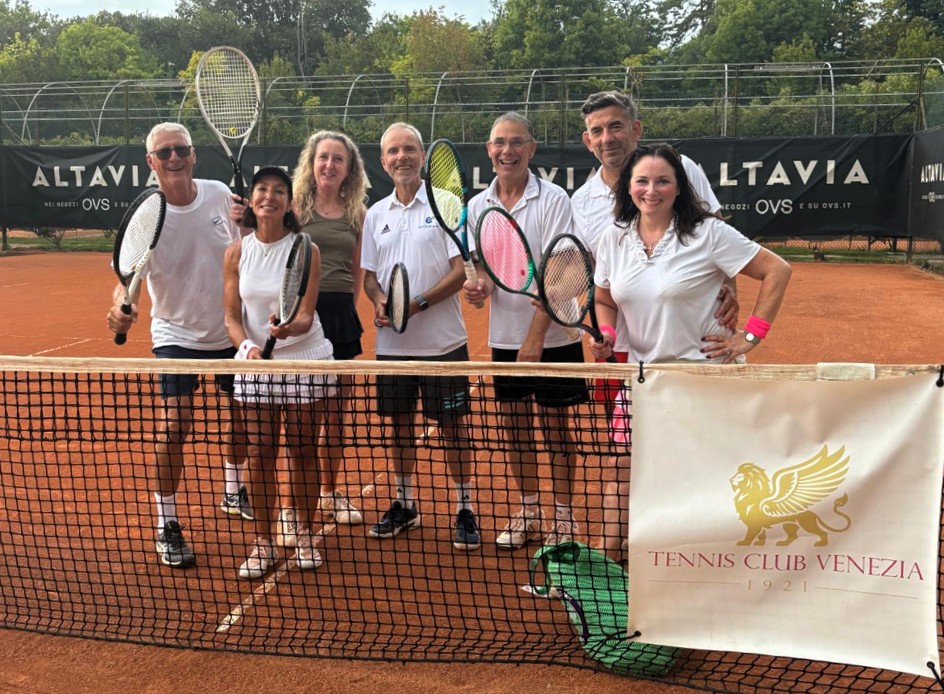 Recently, an East Glos team participated in the 50/60 age category tournament hosted by the Tennis Club Venezia. Sitting on Venice Lido, the club offers majestic views of the city on one side, while the Adriatic Sea gently rolls up onto the beaches on the other.
Taking up the challenge for the trophy on behalf of East Glos were Chantal and David Ball, Sandy Chambers, Angie and Stuart Mico, Martin Tracey, and captain Steve Osborne.
Also taking part was a second UK team, Northern Lawn Tennis Club, Manchester. They lost to Tennis Club Venezia in the second semi-final and would go on to play the Dutch team in the third- and fourth-place play-off match.
In the semi-final, East Glos faced the Netherlands team, Haagsche Lawn Tennis Club from Leimonias. This was a tie awash with dramatic moments, inspired and tenacious play, riveting exchanges, and, most of all, swings of fortune reaching titanic proportions.
Steve Osborne took the men’s 60s singles with an impressive 6-0, 6-0 victory, and Angie Mico won the ladies’ 50s singles in a grinding encounter 6-3, 6-4, giving East Glos an early two rubbers to one lead.
Narrow reverses in the ladies’ 60s singles and men’s 50s doubles saw the balance tilt back towards Leimonias, who looked poised for victory. With Steve and Martin comfortably taking the men’s 60s doubles, the tie was even.
All attention now turned towards the ladies’ doubles in what became a frenzied shoot-out for the final. Demonstrating poise and steadiness, Chantal Ball and Sandy Chambers took the ascendancy, winning the first set 6-2. In exciting exchanges and punishing rallies filled with suspense, they managed to cross the line 6-4 in the second set, achieving a place in the final. An excellent all-round team performance.
Tennis came to Italy via the Côte d’Azur, initially with privileged Victorian society, and with the expansion of the railway network, which cut the journey time from Paris to Cannes from days to a mere twenty hours.
The tourists originally escaping the harsh Northern European winters eventually became British expatriates, and with them came their games, especially the new game of tennis. Setting up communities along the Mediterranean, the Italian border was crossed in 1878, and history was made when Bordighera Lawn Tennis Club became Italy’s first tennis club.
Several others quickly followed: Tennis Club Genova in 1893 and Tennis Club Sanremo in 1897. One year later, the sport reached Florence with the founding of the Circolo del Tennis Club.
Most of these clubs still exist today. Some are now members of the CTC, and many can trace their origins back to British roots. The colourful character Count Giuseppe Volpi of Misurata is credited with founding Tennis Club Venezia in 1921, during a second wave of new tennis clubs at a period often referred to as the Belle Epoque. As the club developed, a tournament was introduced for the Tarhe Volpo trophy, attracting the leading Italian players of the day; Nicola Pietrangeli, Orlando Sirola and Beppe Merlo, occasionally interspersed with notable overseas players.
Throughout the 1930s the club reached unprecedented levels of prominence in Italian tennis. Yet the curtain had already started to fall on this particular period of world history. By the outbreak of World War II, the expatriate communities had already departed for home, and very few would return.
When the club reopened its gates in 1947, Europe had changed dramatically. Today the membership is varied and diverse. While cherishing its history and heritage, the club is also making its mark for the future through close links to the Coppa Valerio tournament for Europe’s top junior players.
In 2022, exactly 100 years after its founding, Tennis Club Venezia became a CTC member. Although one of the smaller clubs within the association, it enjoys an intimate and picturesque location.
In the final, East Glos faced the hosts, who fielded a team of highly experienced clay-court players, able to exploit every advantage of this unique surface with steadiness and tenacity during grinding rallies, meticulous spin, and counterpunching. An intriguing encounter that became ever more challenging.
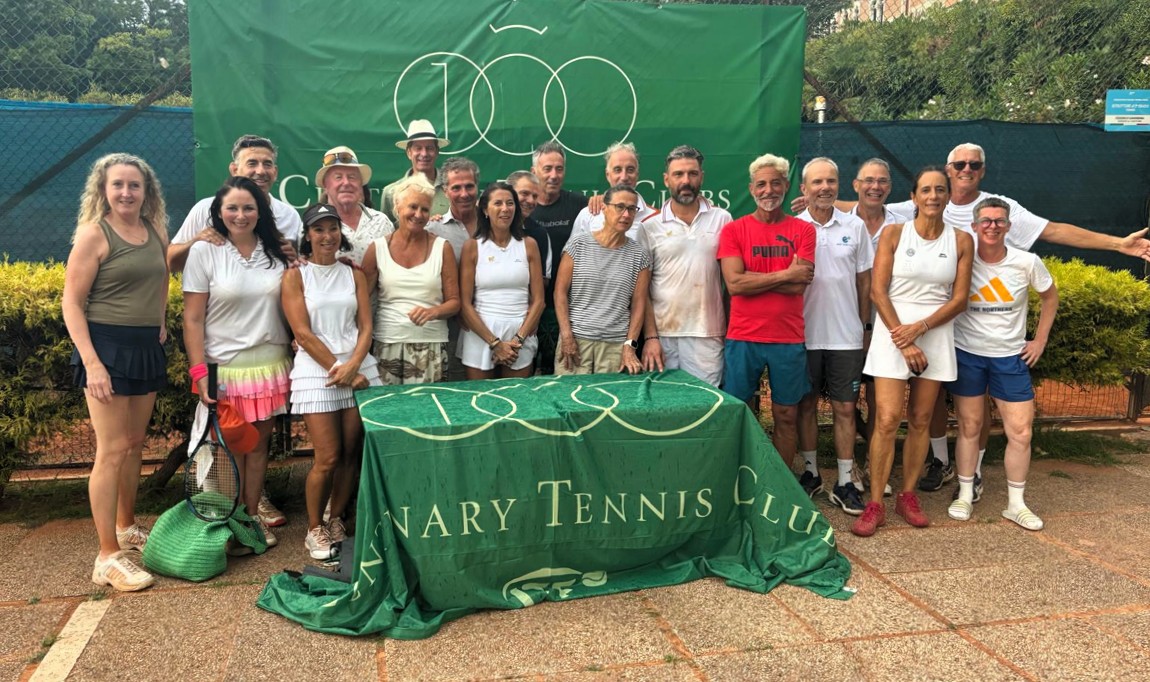
Despite some inspired play from Martin Tracey in men’s 60s singles and David Ball and Stuart Mico in the men’s 50s doubles, momentum and the scoreboard continued to move in favour of the home team. Sandy Chambers would, though, scale the heights in the ladies’ 60s singles rubber. The first two sets were split 6-3, 5-7. Moving well throughout and hitting big when required, Sandy rallied strongly in the match tiebreaker to win it impressively 10-4.
This was an outstanding team effort but not quite enough to take the tournament title. Competing in a strong field, the runners-up berth was, however, an impressive achievement.
Of course, what happens on court matters at any precise moment. But what really matters are the memories created and the moments which stay with you. The people you played with and those on the other side of the net: the handshakes, drinks shared with the indulgence of pleasant conversations. The tournament dinner provided that opportunity to renew old acquaintances and create new friendships. Hands across the net, hands across borders, hands across the sea and friendships through tennis are the gold standard of the CTC.