
Centenary Tennis Clubs: Memorable Côte d’Azur trip for East Glos members
By David Barham, East Glos CTC coordinator
East Glos is proud to be a member of the Association of Centenary Tennis Clubs (CTC), comprising 98 clubs in 29 countries. East Glos members regularly take part in CTC tournaments. These events give clubs and members the chance to combine tennis and leisure. A group of club members recently visited two clubs on the Côte d’Azur.
Between the late nineteenth and early twentieth centuries, a particular stretch of the Mediterranean coastline from Cannes to Genoa became known as the English Riviera. It became a retreat for those seeking a mild climate during the harsh British winter.
 In late October 1883, coincidentally the same year the East Glos Club was founded, the illustrious tennis-playing twins from Cheltenham, William and Ernest Renshaw, travelled to the Côte d’Azur. Exactly 143 years later, an East Glos team comprising Dave Barham, Ken Dawson, Mandy Walker, Nigel Watson, Sue Wilson and Elizabeth Yin would follow in their footsteps.
The brothers, already transforming tennis from a pastime into a sport, quickly took advantage of the clement weather to practice during the winter months and returned each winter for the next 12 years. Although a small tournament was held in Nice as early as 1879, the Renshaws’ presence helped popularise the game and left an indelible mark.
By the end of the decade, the curtain had finally fallen on the Renshaw dominance. However, the foundations were in place, and by 1902 open tournaments were being held at Cannes, Nice, Menton and Monte Carlo. Their legacy was an established tournament calendar and a sport raised to international status. In a final farewell, Ernest would formally open the new tennis courts at the Hotel de Paris in Monte Carlo in 1893. In homage to these fellow Cheltonians, the East Glos team would start their adventure here.
After a photo opportunity on the site of the old tennis courts, now the square in front of the casino, the team were welcomed at the Monte Carlo Country Club. Lunch on the clubhouse terrace offered the perfect opportunity to take in a picturesque view that has become one of the most breathtaking in tennis today, with terracotta-coloured clay courts overlooking the deep blues and turquoise of the Mediterranean below. An image which greets the leading men on the tour each spring and announces the start of the European clay court season.
An afternoon exploring the club, with time on the famous courts, concluded with a light meal and drinks on the clubhouse veranda. While enjoying the atmosphere, the East Glos team presented Chloe, a member of the MCCC team, with our club history and a plaque commemorating our visit.

The tour continued over the Italian border along the beautiful Ligurian Riviera to Alassio.
If Monte Carlo is iconic, then the Hanbury Tennis Club might be described as Renaissance and quintessentially English. Timeless yet modern, and fully woven into the town’s fabric and history.
The club laid on a light lunch for the East Glos team, after which they played a friendly inter-club match. The outcome: after nine closely contested rubbers, the visitors won 6-3. Yet the balance of play was much closer than the score might suggest. Mandy Walker and Nigel Watson were consistently solid throughout and returned some impressive results. Sue Wilson and Ken Dawson supported strongly with moments of inspired play and shot-making. At the same time, Elizabeth Yin and Dave Barham were engaged in the rubber of the day, one with wild swings of fortune and extended duration. The outcome was decided on a tiebreak, 12-10 to the visitors.
The match was both a celebration of tennis and friendship. A celebration which continued late into the evening. It began with drinks and snacks, then moved on to a full meal. During the evening, the East Glos team made a presentation of an autographed copy of the club history together with a plaque, as an expression of thanks and gratitude to the host club in recognition of a warm welcome and hospitality which had been extended to them.
The team returned the following day at the invitation of the club owner Joseph Skordis, or Jo as he is widely and fondly referred to. After some more casual tennis, Jo gave us a personal tour of the club, along with details of its impressive history. The Alassio Tennis Club was initially created in 1893 with just one court. They played friendly games against neighbouring clubs from Sanremo and Bordighera, and are recognised as the oldest club in Italy and now an academy.

By 1911 the club had 50 members and two courts. The Hanbury family had always played an important role in the club, and in the early 20’s Daniel Hanbury purchased a large plot of land just west of the railway station. There, with an ambitious plan, he created a modern tennis club with a two-storey colonial-style clubhouse and eight clay courts. The club was officially founded in 1923 as the Hanbury Tennis Club, and René Lacoste is reputed to have attended the inauguration.
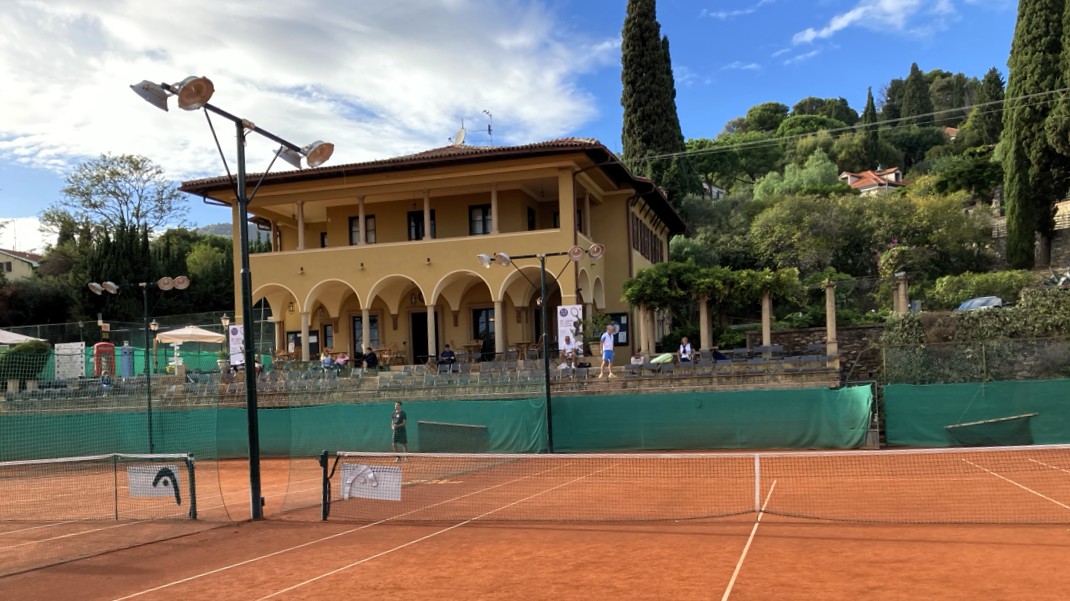 These were the golden days of the sport, when Italian tennis experienced rapid expansion in clubs and players. Over the next twenty years, the club’s reputation grew and attracted some of the leading players of the day to its tournament: Jacques Brugnon, one of the four musketeers, Suzanne Lenglen, Elizabeth Ryan, Helen Wills, and German Cilly Aussem, all Wimbledon champions.
Pat Hughes, best known as a member of the successful British Davis Cup team. Hungarian Bela Kehlring, who also played football for his national team. They also included emerging Italian players Giovanni Palmieri, Lucia Valerio, and Giorgio Stefani.
In 1928, the Australian Davis Cup team prepared for their quarter-final against Italy at Hanbury; the team included Jack Crawford, who became one of the greats of the game, and Harry Hopman, who became a legendary coach. More recently, Roger Taylor, Cliff Drysdale, Roscoe Tanner and Elina Svitolina have all graced the courts at Hanbury.
For many decades, Daniel Hanbury’s widow, Ruth, kept the club going, but by the mid-70s she was now in her eighties and no longer enjoying good health. In 1977, Jo stepped forward and formalised the club’s purchase. Jo, who had promised to maintain the club’s traditions, was better than his word.
 The clay courts were renovated, and state-of-the-art drainage was installed. Floodlights were introduced and the clubhouse facade restored to its former glory. The clubhouse itself was modernised, but retains its charm from the 1920s.
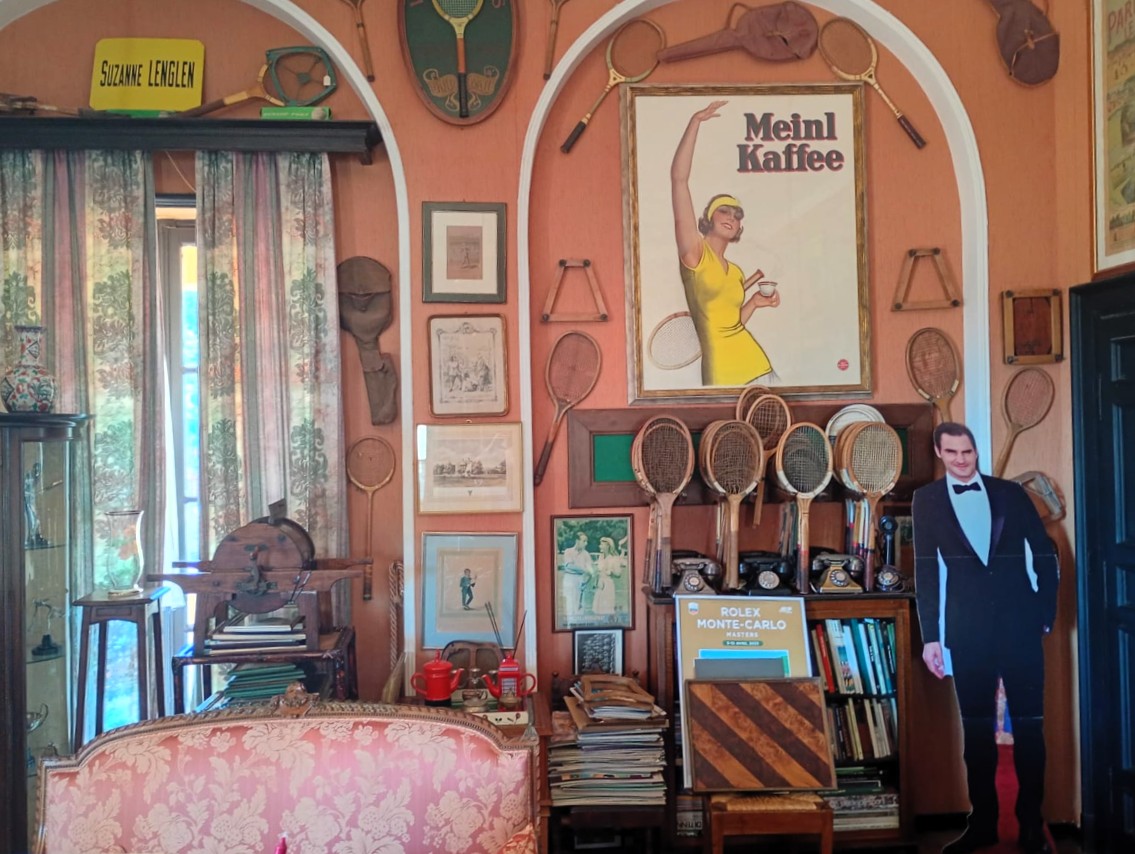
Over the years, Jo has assembled what can only be described as a treasure trove of tennis artefacts and memorabilia: photographs and posters, many portraying the club’s history; rackets from across the decades; chairs with tennis emblems; mugs and plates; an ancient ball cleaning machine, and in pride of place a tennis themed pendulum clock, one of a pair, the other standing in the All England Club.
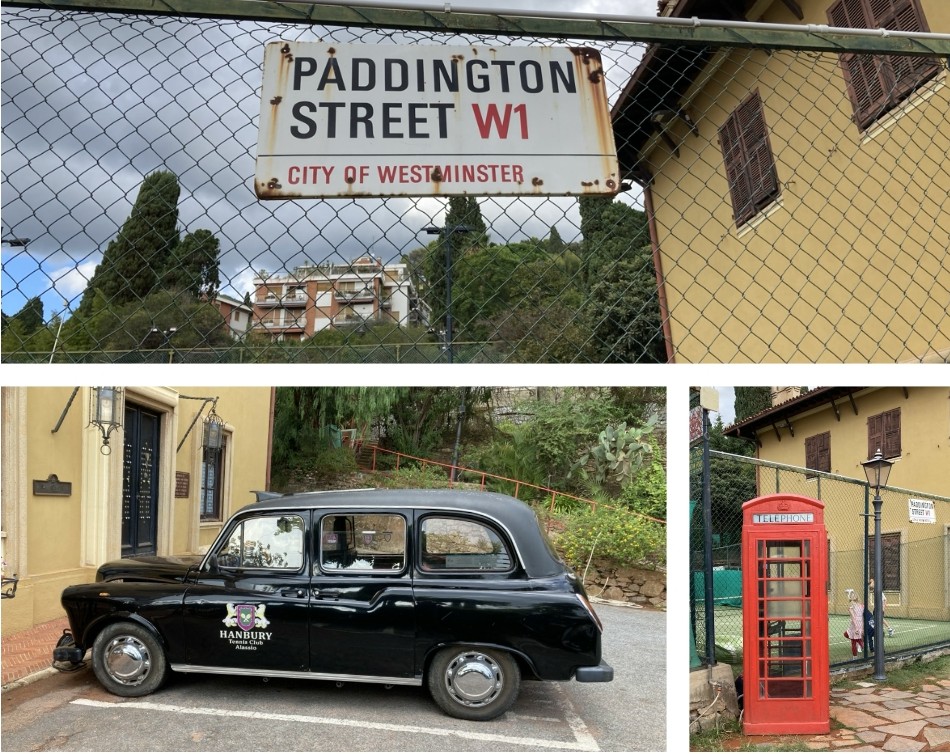
In the grounds, there is a London taxi and street lamps, an old red telephone box, old red postboxes, and even a police telephone box. The pathway in front of the clubhouse bears the name Paddington Street.
Clearly, Jo carries a sense of responsibility for tennis history and heritage, as many of the items he has assembled would be valued treasures in any tennis museum, and he helps make Hanbury a historical venue. Today, his son John, an accomplished tennis and padel player, takes on many of these responsibilities, and three padel courts were recently added as a feature of the club.
The club celebrated its centenary in 2023, and became a worthy member of the Association of Centenary Tennis Clubs this year. The club made us feel so welcome; it was difficult to leave, but promises of a return were made. Over breakfast on the final day, it was difficult not to reflect on the experience: the charm, location and history of the clubs visited. We had also drank from the cup of hospitality and friendship, built into the heart and spirit of the CTC.
The birth of open tennis has transformed the game. But as a consequence, some smaller clubs that once hosted major tournaments have disappeared from the tournament calendar, and the Riviera is no exception. Of all the clubs that formally hosted events, only Monte Carlo, which hosts the Rolex Masters each April, has survived.
However, for members aged over 35, there remains the opportunity to visit several of these clubs that continue to feature on the ATP seniors tour: Beaulieu, Menton, Antibes, and Hanbury in Alassio being the most prominent. The ATP calendar for 2027 should appear by mid-November on the ATP website. If you enjoy tournament tennis and would like a taste of the old Riviera tournament circuit, the ATP website is worth a glance.
East Glos has been a CTC member now for three years. Early next year we hope to announce forthcoming CTC tournament events, both friendly and competitive. In addition, our CTC membership also includes the reciprocal program, which enables members to play at CTC member clubs.
Read more about our CTC membership and how to play at member clubs globally.